Posts

Showing posts with the label Profiles in Virtue

Profiles in Virtue - Egil Skallagrimsson's Utter Shamelessness

Image
"Yeah, I totally stole this sword, what are you going to do about it?" It is said that, in the district of Sogn, in Norway, there lived a man named Ulf.  This man, who was of good stock, was known for his great good cheer, but toward evening became quarrelsome and difficult, so he became known as Kveldulf, that is, "evening-wolf."  Kveldulf married a woman named Salbjörg, who was kin to Ketill Trout, and had two sons, Thorolf and Grim.  Thorolf was a fair-featured man, well beloved by all, but Grim was remarkably ugly and even in his youth known as Bald Grim, that is, Skalla-Grim.  Thorolf served King Harald Fair-Hair, and when Harald killed him, Grim and Kveldulf fell to quarreling with the king.  The quarrel led to them departing Norway and moving to Borg, in Iceland.  Kveldulf died before they made land, and Grim followed his father's coffin to decide where to raise his hall.  In time, Grim had two sons of his own, Thorolf and Egill.  Thorolf w...
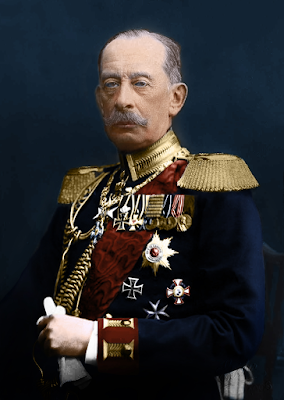
Profiles in Vice - Alfred von Schlieffen, the German General Staff, and "Just Because You Can..."

Image
Just as with loyalty, which was my first focus, it was difficult at first to find an example of diligence transformed from virtue to vice.  As it happens, my current audiobook is Barbara Tuchman's The Guns of August , about the first month of the First World War.  That's where today's post came from. Prussia in the age of Frederick the Great was called "an army with a state."  Of course, Napoleon handily demonstrated that that army, untethered from the genius of Frederick, was about the same as any other Napoleonic-era military force (a lesson that France should've taken note of - elan  is insufficient by itself!).  As a reaction to this, a series of reformers in the late-Napoleonic period, most notably including Clausewitz and Scharnhorst, professionalized the officer class in much the same way that the Royal Navy professionalized over the 18th Century.  Their reforms included an emphasis on staff work and planning, and the creation of a war-plans division...

Profiles in Virtue - Heloise, or, Finding A Way

Image
It would be easy to conclude, based on my posts so far, that "virtue" is all a matter of men and arms, and that it is specifically devoted to various approaches to combat.  Nothing could be further from the truth; despite its Latin roots, virtue sees no gender, no sex, no race, no creed, no color, no profession, and no calling.  It is different things in different times and places, but anyone can practice it. As an example, I offer Heloise, of the Abbey of Paraclet, who has the distinction of being better-known as part of a tragic romance than on her own.  The male half of said romance, Pierre Abelard, would have been better-served by being a theater kid in another century, so fond was he of dramatic scenes.  One can almost hear the emo-kid eyeshadow in quotes like "Logic has made me hated in the world."  In comparison, Heloise, who enters history first as a teenager, is remarkable not because of her love of drama, though there are plenty of dramatic lines to H...

Profiles in Virtue - Yagyu Munenori - "No Magic, Just Practice."

Image
As I discussed indirectly in the cases of William Marshal and Yamamoto Tsunetomo, there is a correlation between being well-rounded and being virtuous.  It is not causation; it is possible to be a well-rounded scoundrel, as, for instance, Gilles de Rais.  However, being a jack of all trades, and master of at least one, is a good way to stand out from the pack.  It should be at least an entertaining exercise to highlight what someone does best, because there should be multiple reasonable choices. So it is with Yagyû Munenori , who was the personal sword instructor and advisor to three generations of Tokugawa shoguns, Ieyasu , Hidetada , and Iemitsu .  He was the head of the Edo line of Yagyû shinkage-ryû and author of what could be described as its school text, the Heihô Kadensho , which has a singular advantage over the better known Book of Five Rings , in that Munenori also gave a series of drawings illustrating his school to an actor with whom he was especially im...

Profiles in Vice - Yamamoto Tsunetomo, Hagakure, and Loyalty as Self-Indulgence

Image
When I started this series, one of the points I raised was that virtue carried too far becomes vice.  It is difficult to find a good example of how loyalty carried too far becomes a vice; we typically find reasons that a person who carried their loyalty too far was acting for some other  reason, such as with the German army hiding behind the "sacred honor of the German soldier" and the fact that the influencers of the German army generally agreed  with Hitler or at the very least did not find him objectionable, but were more concerned with his incompetence.  They were not holding their noses and doing it out of professional loyalty, they were doing it out of self-interest from beginning to end. Instead, I will consider a man who carried expressions of loyalty to such extremes that they became absurd and weakened his credibility.  That man is Yamamoto Tsunetomo, subject of Hagakure.   We know relatively little about the man outside of that book, so the book ...

Profiles in Virtue - Minamoto no Yoshitsune

Image
As with most of the figures I have discussed so far in this series of posts, it is very difficult to assemble an accurate picture of Minamoto no Yoshitsune; one might reasonably describe him as in the same company as Arthur and Roland in terms of historicity.  There's something clearly there , but exactly what is subject to vigorous debate.  What we know is that the man existed, that he was an influential figure in his time, and that his memory was strong enough to pull even the most extravagant tales to attach themselves to him - raised by goblins, capable of impossible feats of grace and swordsmanship, loyal to his brother beyond all reason. Minamoto no Yoshitsune.  Not shown: Bishounen. Let us first set the man in his place.  In the middle of the twelfth century, Japan was not so much a country as a loose grouping of families bound together by a reverence for the imperial line.  Simplifying things tremendously, a shift between the old court aristocracy and t...

Profiles in Virtue - Liu Bei, Guan Yu, and Zhang Fei - The Oath of the Peach Garden

Image
The gentleman on the left, observing the Oath, just wants to be done with the whole sworded affair. In some stories, such as that of William Marshal, telling how much of his legacy is the product of friendly chroniclers, and how much is the truth, is difficult.  This is not one of those stories.  This is, instead, the story of an event that almost certainly never happened, but has become its own sort of cultural touchstone. That event is the Peach Garden Oath, which brings together the hero and his two main supporters in the Romance of the Three Kingdoms.   Before discussing the fictional version, one must separate the Romance from the very similarly titled Records of the Three Kingdoms .  The Records was a respectable historical work, written very shortly after the reunification of the titular three kingdoms from primary documents, and was a scholarly work that included both moral lessons and strict recollection of facts.  It can be thought of, broadly, as a...

Profiles In Virtue - William li Marischal, "The Greatest Knight Who Ever Lived"

Image
For the first of these posts, on a thoroughly appropriate day, I am taking a very easy subject: William Marshal , first Earl of Pembroke, known in his lifetime (as was Charny) as the greatest knight who ever lived.  Marshal lived from about 1147 to May 14, 1219, served five kings - three of them named Henry, and one of them generally all but forgotten today - was the one man who is known ever to have unhorsed Richard the Lionheart, was one of the four men that same worthy trusted to govern England while on Crusade, and was one of the prime negotiators on Magna Carta. Effigy of William Marshal.  No jokes here. With such an impressive life, it is easy to forget that William Marshal was, for all intents and purposes, a mercenary.  The difference between Marshal and other, equally influential men who were equally hungry for rewards, lands, and honors is that Marshal could not be bought twice.  This drew him praise in his own time; what, therefore, were the a...

Profiles in Virtue: A New Series of Posts

Image
It's been on my mind recently that we aren't great at accepting our heroes.  There's a story in Plutarch's Parallel Lives about Aristides , an Athenian politician and general who was nicknamed "the Just" in his own lifetime, who was out walking and came across an old farmer trying to cast his vote in the annual ritual known as ostracism, where a single citizen of Athens could be exiled for ten years if six thousand Athenians voted for their exile.  The farmer was illiterate, and asked for Aristides to help him write his vote... for Aristides.  When Aristides asked why, or if Aristides had somehow wronged him, the farmer simply said it irritated him to hear Aristides constantly referred to as "the Just."  Aristides scratched his name on the potsherd, and went on his way. This illustrates quite well that we've enjoyed taking popular figures down a peg for a very long time - it is older than feudalism . It's also not a peculiarly European phen...